Buyers and reviewers dealing with imported, high-value vehicle paperwork across sellers, jurisdictions and multiple document types.
03 / 03
Selected work
Selected work
Evidence & risk workflow
AutoProof
Make the paperwork reviewable before money changes hands.
Overview
What the product is—and why it needed to exist.
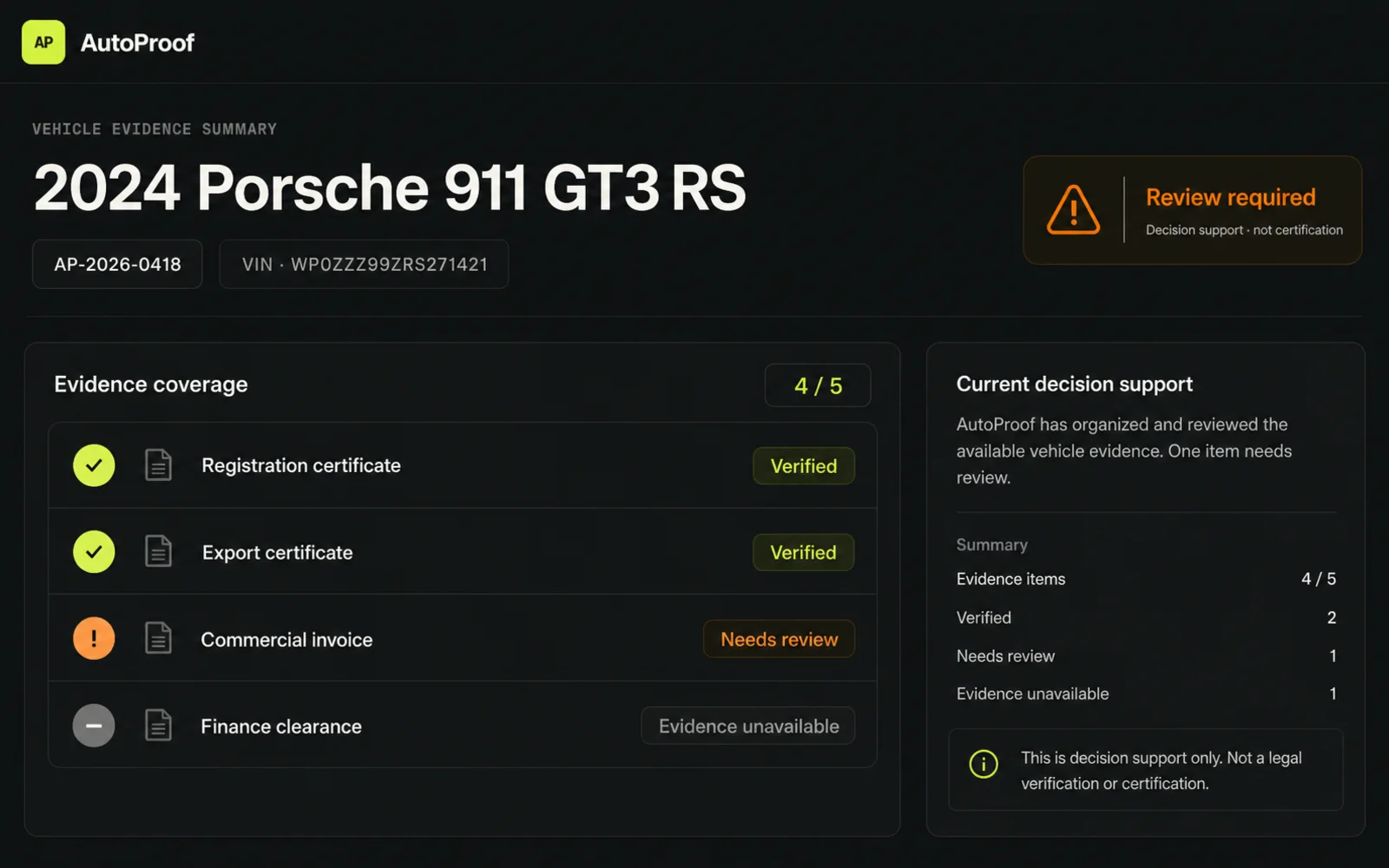
A live educational prototype for organizing vehicle due diligence across documents, inconsistencies, review notes and an integrity-receipt demonstration.
Manual review scatters registrations, invoices, export records, inspections and finance-clearance evidence across files and conversations. Conflicts are easy to miss and the reasoning trail disappears.
Organize the evidence chain, surface inconsistencies and preserve reviewer notes—while stating clearly what the product cannot verify or certify.
Product states
Multiple parts of the working system, rendered as one coherent product story.
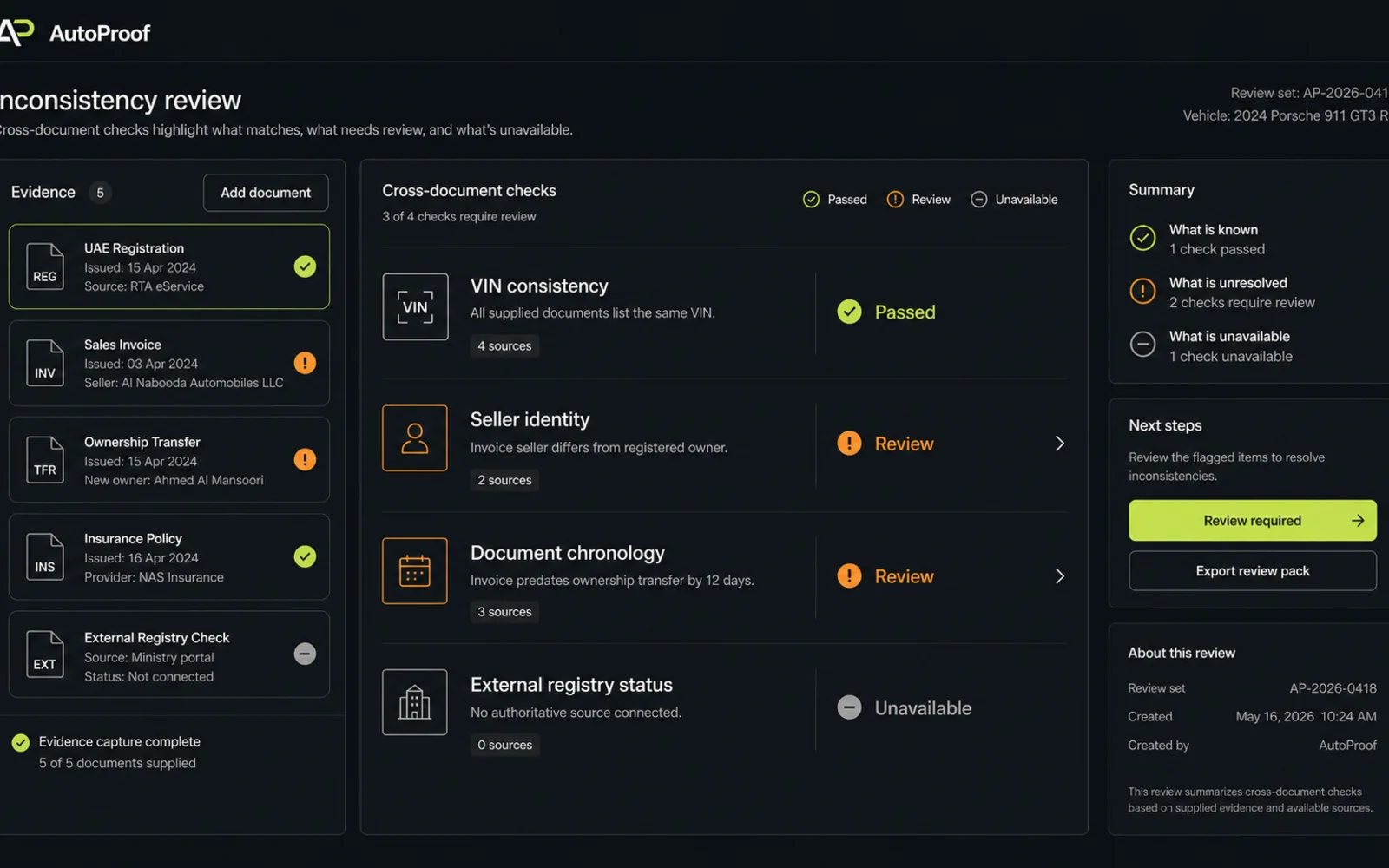
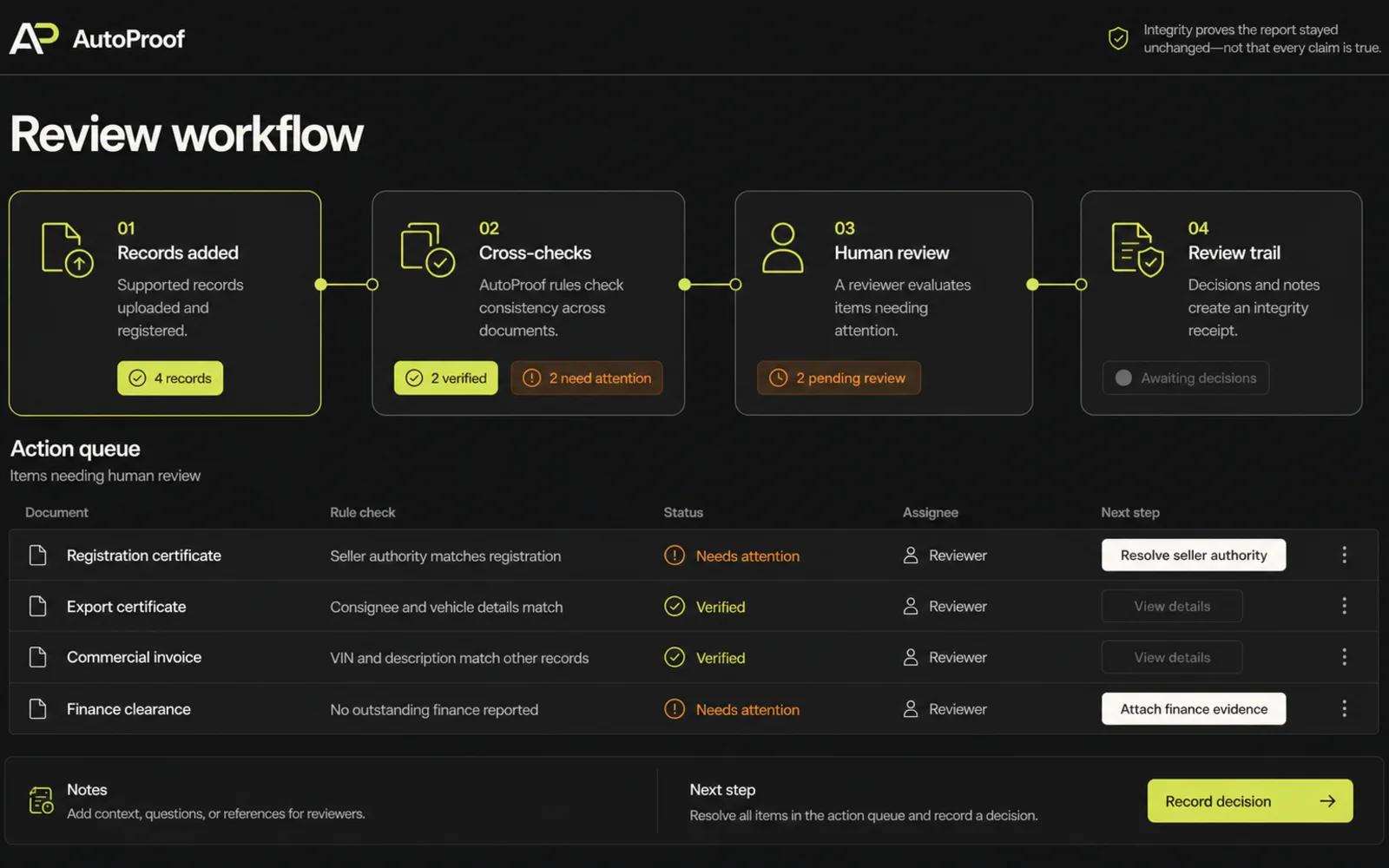
How can software help someone make a high-stakes decision without pretending it knows more than the available evidence supports?
My role
Product ownership across the system.
The contribution is described at the level supported by product records: strategy, workflows, requirements, design decisions, orchestration, QA and release judgment.
- Risk-workflow and evidence architecture
- Product safeguards and limitation design
- Decision logic, content scope and UX for uncertainty
- Responsive implementation and product QA
Product architecture
A simplified, truthful system view.
Only implemented or documented boundaries are shown. The diagram communicates product responsibility rather than claiming infrastructure scale.
React + TypeScriptVinext App RouterDeterministic demo rulesBrowser-session file intakeStructured review notesSimulated receipt
Key decisions
The product is the decisions.
The interface follows from choices about trust, state, ownership, evidence and what the system should refuse to imply.
Define the boundary before the score
AutoProof does not certify ownership, authenticity, legal status or theft status. The interface makes those limitations part of the workflow.
Treat a transaction as an evidence chain
Vehicle identity, authority to sell, import clearance, history, finance, inspection and payment should point to the same vehicle and parties.
Use deterministic demo logic
A repeatable fictional case makes review behavior inspectable without implying access to authoritative registries or licensed data providers.
Keep uploads local
Files added to the demonstration remain in the browser session and are not stored or analyzed.
Trade-offs
Useful means knowing where to stop.
Each product is designed around a boundary: automation can support the decision, but cannot manufacture certainty or erase human responsibility.
Decision support vs. false assurance
A clear risk score can orient attention, but it must never be presented as certification or professional advice.
Auditability vs. convenience
Review notes and source coverage add work, but they preserve why a buyer accepted or escalated a risk.
Integrity vs. truth
A hash can indicate that a file did not change; it cannot prove that the underlying document was truthful or legitimately issued.
Product flow
From input to a defensible next action.
The flow is intentionally legible. Users should understand what entered the system, what changed and where judgment remains theirs.
Define transactionInventory evidenceRun consistency checksReview gapsRecord decisionPrint review trail
What shipped
Working capability, not slideware.
Shipped means the capability is present in the repository and product record. Current-state language below keeps release status and adoption claims separate.
- 22 original source-aware buyer guides
- Six-question pre-purchase risk checklist
- Example cross-document consistency review
- Missing-evidence and review-note states
- Printable review report
- Simulated cryptographic integrity receipt
- Responsive desktop and mobile experience
What I learned
In a high-stakes product, credibility comes from making the evidence boundary visible—not from making the result sound more certain.